
Table of Contents
- The Myth vs. The Mathematics of the New Manager Bounce
- Structural Decay Functions and Identifying Sacking Points
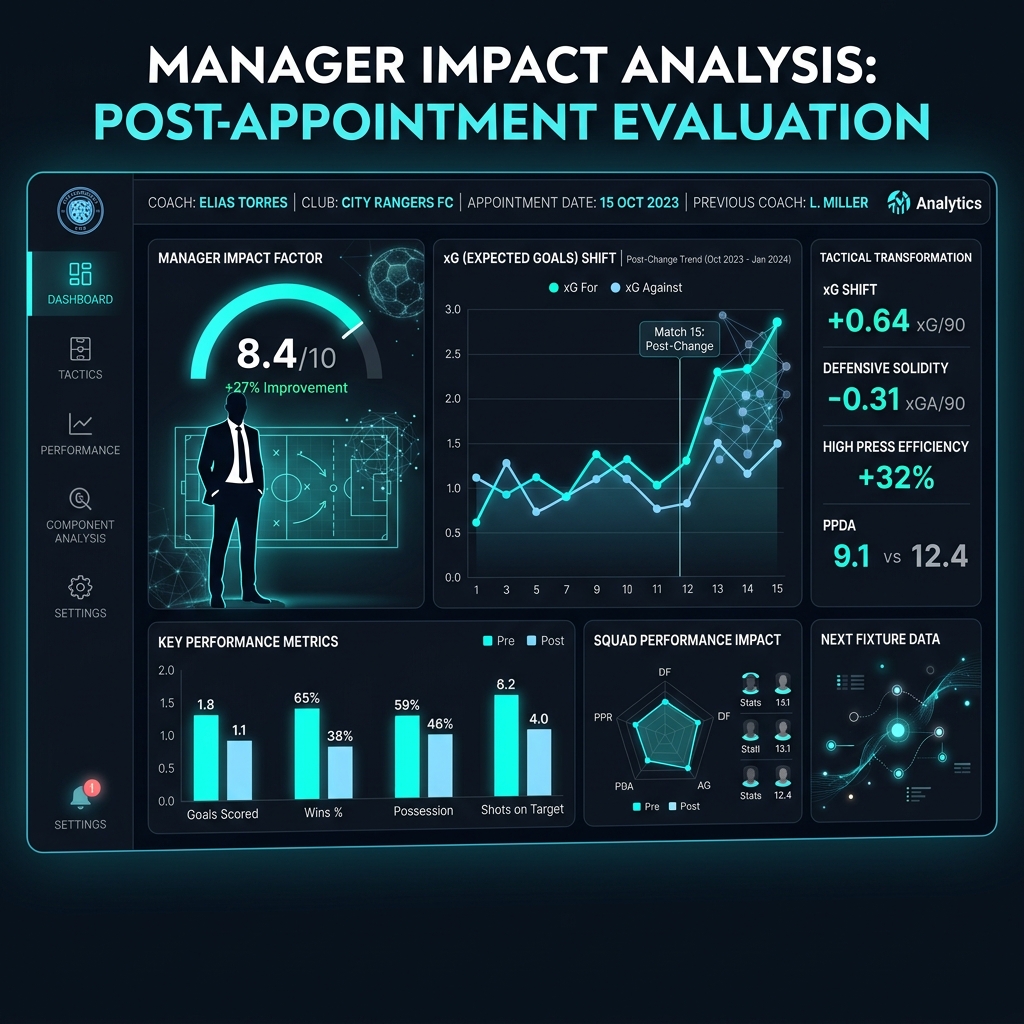
- Tactical Shifts and the Re-calibration of Expected Goals (xG)
- Modeling Managerial Matchups: The Elo Rating of Managers
- Exploiting Market Inefficiencies and Capturing CLV
- Derivative Markets: The Hidden Value in Disruption
- Monte Carlo Simulations and the Distribution of Outcomes
- Conclusion: Embracing the Variance
The Myth vs. The Mathematics of the New Manager Bounce
The "new manager bounce" is perhaps the most pervasive trope in football punditry. When a struggling club sacks its manager and appoints a successor, the public overwhelmingly anticipates an immediate, albeit temporary, surge in form. Bookmakers are acutely aware of this psychological bias and artificially suppress the odds on the team with the new manager. For the recreational bettor, backing the "bounce" often yields a negative expected value (-EV) return due to this inherent public tax.
However, professional sports betting syndicates and quantitative hedge funds do not operate on media tropes. They understand that a managerial change introduces extreme variance into a previously stable, albeit decaying, dataset. The role of an Artificial Intelligence (AI) model is not to blindly predict a miraculous win, but to mathematically deconstruct the new tactical framework, re-weight historical player data, and project the likely shift in Expected Goals (xG) and Expected Goals Against (xGA).
By utilizing Monte Carlo simulations, Poisson distributions, and advanced gradient-boosted decision trees (like XGBoost or LightGBM), AI models can filter out the noise of media narratives. They isolate the true probability of a tactical renaissance versus a continued structural collapse, allowing sharp bettors to exploit the discrepancy between public perception and mathematical reality.
Structural Decay Functions and Identifying Sacking Points
Before an AI model can assess the impact of a new manager, it must first rigorously understand why the previous manager was terminated. In sports data science, this process is modeled through a concept known as a "Structural Decay Function."
A football team's performance degradation is rarely a linear progression. When a manager's philosophy begins to fail—whether due to a lost dressing room, tactical obsolescence, or severe injury crises—the team's underlying performance metrics (xG, xGA, Passes Per Defensive Action [PPDA], and Field Tilt) experience a non-linear decay.
An advanced AI model tracks this decay through moving averages, typically utilizing 5-match and 10-match rolling windows. When the variance between a team's long-term historical baseline and their short-term rolling average exceeds a specific standard deviation threshold, the model algorithmically flags the team as undergoing structural decay.
Crucially, the model differentiates between "unlucky" teams (teams with high xG, low actual goals, and high variance in finishing) and "broken" teams (teams with catastrophically low xG, high xGA, and a collapsing PPDA). If a manager is sacked when the team is merely "unlucky," the AI anticipates a natural, mathematically inevitable regression to the mean under the new manager, heavily weighting the "bounce." Conversely, if a manager is sacked when the team is fundamentally "broken," the AI requires significant tactical adjustments and personnel changes to project improvement. The betting public cannot distinguish between these two distinct statistical states, leading to mispriced lines that the AI can readily exploit.
Tactical Shifts and the Re-calibration of Expected Goals (xG)
The core computational challenge for any predictive model when a new manager arrives is the immediate obsolescence of recent historical data. If a team transitions from a manager who deployed a low-block, counter-attacking 5-3-2 system to a manager who insists on a high-pressing, possession-based 4-3-3, the previous 20 matches of aggregated team data become heavily skewed and potentially toxic to the model's accuracy.
To counter this data obsolescence, advanced AI models utilize a process of "Tactical Re-calibration." The algorithm strips away the macro-level team data and drills down into granular, player-specific metrics. It assesses the historical performance of the current squad members under similar tactical frameworks in their past (e.g., at previous clubs or under previous national team managers).
For instance, if the new manager relies heavily on overlapping fullbacks to generate cross-assisted xG, the model evaluates the crossing accuracy, stamina, and progressive passing metrics of the squad's current fullbacks. If the squad lacks the requisite personnel to execute the new system efficiently, the AI projects a significant transition period, effectively fading the expected "new manager bounce."
Furthermore, the AI actively adjusts the expected game state. A shift to a high-pressing system inherently increases game variance. It leads to more high-turnover situations (drastically increasing xG) but also leaves the defensive transition highly vulnerable (correspondingly increasing xGA). Consequently, the model will automatically adjust the probabilities for derivative markets, such as Over 2.5 Goals or Both Teams to Score (BTTS), recognizing the systemic shift towards a more open, chaotic match structure.
Modeling Managerial Matchups: The Elo Rating of Managers
Just as teams and individual players have distinct power ratings, sophisticated AI models maintain dynamic, constantly updating Elo ratings for managers themselves. A manager's Elo rating is an aggregate score of their tactical flexibility, their historical over-performance of Expected Points (xPts), and their specific success in granular match contexts (e.g., as an underdog away from home, or against deeply entrenched low-block defenses).
When a managerial change occurs, the AI algorithm immediately blends the team's baseline Elo rating with the new manager's historical Elo coefficient. This allows the model to quantify the immediate upgrade (or downgrade) on the touchline in purely mathematical terms.
Moreover, the AI analyzes "Managerial Matchups." Specific managers possess tactical frameworks that inherently counter others. If the newly appointed manager possesses an exceptionally high win rate against the specific tactical system utilized by the upcoming opponent, the model triggers a significant positive modifier.
This level of tactical granularity is impossible for traditional, volume-based bookmakers to perfectly price into an opening line. Bookmakers must primarily cater to the liquidity of the general public, which reacts to the *name value* of the new manager rather than their specific tactical compatibility against the weekend's opponent. This asymmetry in evaluation is the primary engine for generating positive expected value (+EV).
Exploiting Market Inefficiencies and Capturing CLV
The ultimate goal of utilizing AI in the context of managerial changes is the systemic capture of Closing Line Value (CLV). When a sacking is announced, the betting markets enter a state of high volatility and uncertainty. Opening lines are often established using the previous manager's data, with bookmakers manually applying an arbitrary "shock factor" buffer.
AI models, which are continuously ingesting real-time data feeds, recognize these manual inefficiencies instantly. If a model calculates that the true, data-driven probability of a team winning under their new manager is 45% (fair odds of 2.22), but the bookmaker, attempting to hedge against public uncertainty, offers odds of 2.80, the model flags a massive +EV opportunity.
Sharp bettors act on these algorithmic signals immediately, placing substantial wagers while the lines remain soft. As the broader market and other syndicates eventually catch up to the true probability, the odds drop (e.g., from 2.80 down to 2.40). The AI-driven bettor has successfully captured CLV, securing a mathematically profitable position relative to the closing market regardless of the actual match outcome on the pitch. Over thousands of iterations, this systematic exploitation of variance guarantees long-term portfolio profitability.
Derivative Markets: The Hidden Value in Disruption
While the Match Winner (1X2) market receives the bulk of the liquidity and media attention during a managerial transition, AI models frequently locate the most extreme value in secondary, derivative markets. Managerial changes consistently coincide with drastic, predictable shifts in team discipline, corner kick generation, and player-specific performance metrics.
A new manager attempting to instill a high-intensity pressing system often demands a significantly more aggressive physical approach from their midfield pivot. An AI model, analyzing the new manager's historical "Fouls Per 90" and "Cards Per 90" metrics from previous tenures, will project a sharp, immediate increase in the team's disciplinary points. If the bookmaker's pricing algorithm relies primarily on the team's passive historical average under the previous regime, the "Over Total Cards" market becomes highly lucrative.
Similarly, a manager who prioritizes vertical, direct attacking play will naturally generate exponentially more corner kicks than a manager who prefers patient, central build-up. The AI recalculates the expected corner distribution, identifying significant +EV in the Asian Handicap Corner markets.
Furthermore, player-specific props (e.g., Player to Score, Player to be Carded, Player Shots on Target) are particularly ripe for algorithmic exploitation. A new manager may instantly recall a previously frozen-out striker or shift an inverted winger to a traditional, wide-crossing role. AI models that scrape projected lineups, training ground reports, and historical player relationships can project these personnel shifts long before they are accurately priced into the market, offering sharp bettors a distinct, unassailable advantage.
Monte Carlo Simulations and the Distribution of Outcomes
To seamlessly synthesize these disparate, highly volatile variables—structural decay, tactical recalibration, managerial Elo, and derivative shifts—advanced AI models rely heavily on Monte Carlo simulations. The model programmatically simulates the upcoming fixture 10,000 times, injecting the newly defined managerial parameters into the physics engine of the algorithm.
These thousands of simulations produce a comprehensive probability distribution of all possible outcomes. While it reveals the median expected result, its true power lies in mapping the extreme tails of the distribution. A new manager inherently introduces chaos; the team might adapt instantly and secure a dominant 3-0 victory, or the new tactical system might completely collapse under pressure, resulting in a catastrophic 4-0 defeat.
By directly comparing the AI's simulated probability distribution against the bookmaker's implied probability distribution, the algorithm meticulously identifies the precise pockets of value. It may advise laying the draw on the exchange, backing an alternate, heavily skewed Asian Handicap line, or constructing a highly correlated Same Game Multi (Bet Builder) that the bookmaker's standard, rigid correlation matrix has fundamentally mispriced.
Conclusion: Embracing the Variance
Managerial changes are arguably the ultimate stress test of a predictive betting model's robustness. They represent a hard, defining break in the data continuum, rendering simplistic, historical-average models entirely obsolete and highly vulnerable.
For the recreational bettor, a newly appointed manager is a pure guessing game, wrapped tightly in media narrative and confirmation bias. For the professional, AI-equipped betting syndicate, it is a localized anomaly of extremely high variance—a structural inefficiency waiting to be ruthlessly exploited. By mathematically quantifying the impact of tactical shifts, recalibrating individual player metrics, and utilizing advanced Monte Carlo simulations to secure Closing Line Value, data-driven bettors consistently turn the chaos of a managerial sacking into cold, calculable profit.
Stop Guessing, Start Investing
Access the same machine learning models the professionals use. See today's highest +EV predictions across global leagues.
View Today's AI Picks →