
Table of Contents
The Inefficiency of Derivative Markets
The vast majority of liquidity in football betting flows into primary markets: 1X2, Asian Handicaps, and Total Goals. Because sportsbooks take massive liability on these outcomes, their internal modeling for these primary lines is exceptionally sharp. Closing Line Value (CLV) is notoriously difficult to capture consistently in the Premier League 1X2 market without incredibly sophisticated infrastructure.
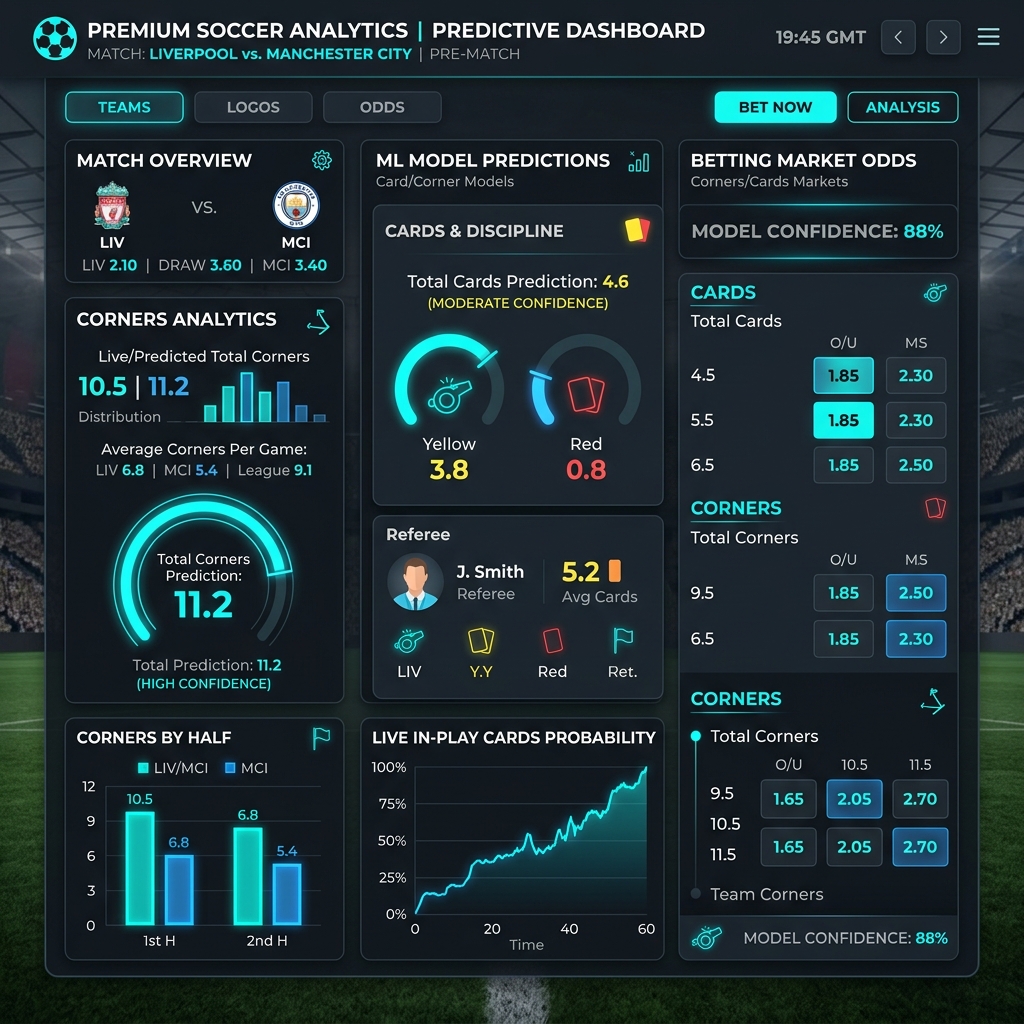
Derivative markets—specifically corner kicks and bookings (cards)—are a different story. Bookmakers traditionally build these lines by deriving them from the match odds. If Manchester City is a massive favorite against a lower-table side, the bookmaker's algorithm mechanically sets the City corner line exceptionally high. This automated, correlated pricing structure creates glaring inefficiencies, and this is exactly where Artificial Intelligence excels.
Modeling Corner Kick Dynamics
Corner kicks are not merely a byproduct of dominance; they are highly dependent on tactical shapes, attacking width, and game state. An advanced AI model breaks down corners through a granular, multi-factor approach.
Game State and Shot Volume
The most significant variable in corner accumulation is Game State. If a heavy favorite takes an early 2-0 lead, their intensity drops, and they often switch to possession-retention strategies, drastically reducing their corner output. Conversely, if a favorite goes 1-0 down to a low block, the resulting siege yields a massive spike in corner frequency.
AI models simulate the timeline of a match thousands of times. By projecting the likely time spent in different game states (drawing, winning by 1, losing by 1), the AI calculates a precise expectation for total corners. Traditional punters just look at "Average Corners For/Against"—a metric completely blind to the context in which those corners were won.
Tactical Matchups: Width vs. The Low Block
Beyond game state, AI analyzes positional tracking data. Teams that attack with high, wide fullbacks and prioritize crosses generate exponentially more corners than teams attacking through central intricate passing. When an AI model detects a high-crossing team facing a defensive unit that defends narrow and clears the ball out of bounds rather than playing out of the back, it flags the Over Corners line as highly +EV.
Predicting Cards and Discipline
Card markets (Total Cards, Player to be Carded) are arguably even softer than corners. The standard bookmaker approach relies heavily on the historical average of the two teams and the baseline strictness of the referee. Machine learning models dig much deeper.
The Referee Matrix
Referees are humans with distinct statistical profiles. AI doesn't just look at "cards per game." It categorizes referees by their tolerance for specific fouls (e.g., tactical fouls in transition vs. reckless tackles). A model will matrix the referee's specific tendencies against the types of fouls the competing teams commit.
Positional Mismatches
The highest +EV in card betting often lies in player-specific markets. AI models analyze direct positional matchups. If a slow, aging right-back is matched up against a left-winger who leads the league in successful dribbles and fouls won (drawn), the probability of that right-back receiving a yellow card skyrockets.
The model calculates the expected duels between these two specific players, adjusts for the referee's strictness, and outputs a true probability. When the bookmaker's standard algorithm prices the aging defender at 4.50 to be booked, the AI might identify the true mathematical odds as 3.20—an enormous edge.
The Monte Carlo Edge
To price these niche markets accurately, top-tier AI systems rely on Monte Carlo simulations. The algorithm plays out the fixture 10,000 times, tracking every event—goals, corners, cards, substitutions—minute by minute.
This simulation accounts for the cascading effects of events. A red card at the 30th minute completely alters the trajectory of the remaining 60 minutes for corner and goal expectations. By aggregating the outcomes of 10,000 simulations, the AI constructs a precise probability distribution for the total number of corners and cards. It then scans the betting markets globally to find any line that deviates from this distribution.
Conclusion: Capitalizing on the Niche
While the primary markets will always draw the headlines, the derivative markets are where professional data syndicates quietly build their bankrolls. Corner kicks and bookings are highly volatile, tactical, and incredibly difficult for bookmakers to price perfectly across thousands of global fixtures.
By stripping away emotion and utilizing AI to analyze game state, positional mismatches, and referee matrices, bettors can unlock consistent +EV in markets the public largely ignores.
Stop Guessing, Start Investing
Access the same machine learning models the professionals use. See today's highest +EV predictions across global leagues.
View Today's AI Picks →