
Table of Contents
The Mechanics of the BTTS Market
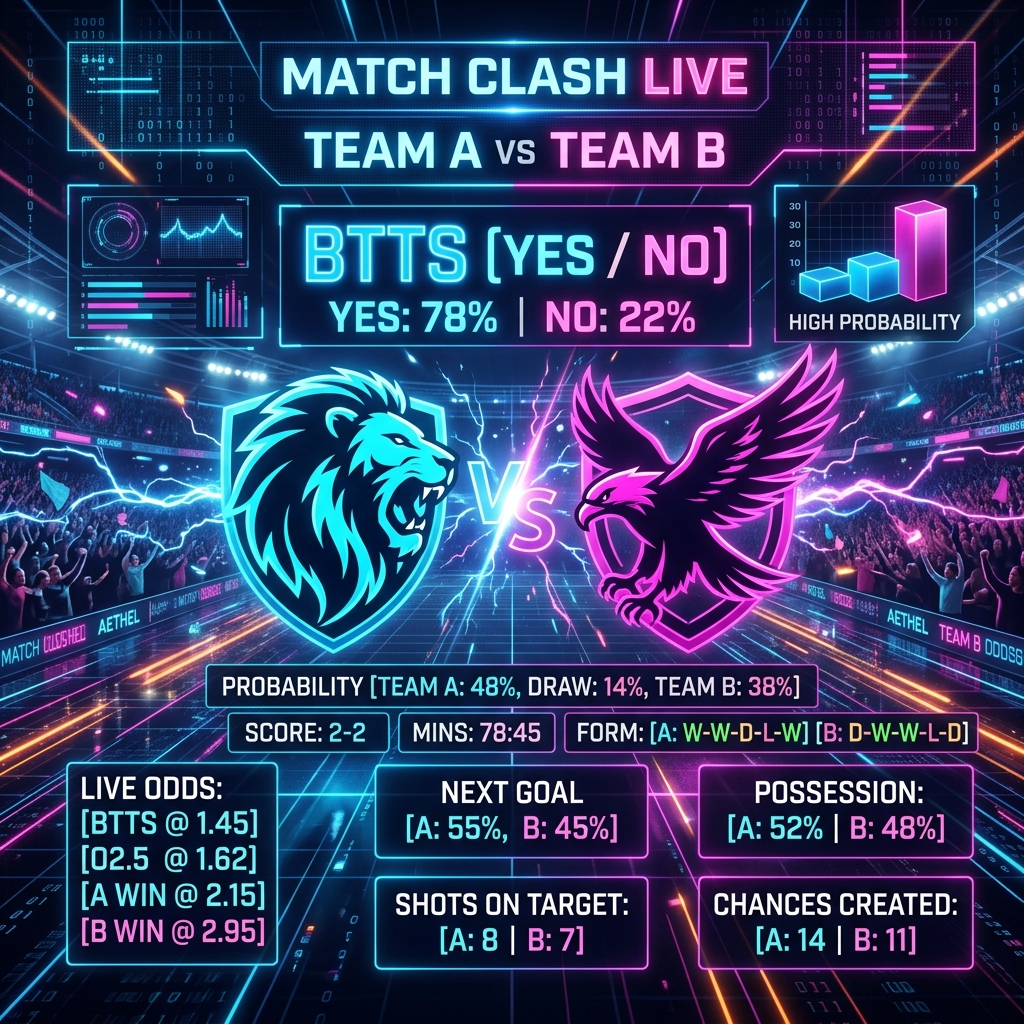
Unlike Match Winner or Asian Handicap betting, Both Teams to Score (BTTS) is entirely binary: Yes or No. You do not care who wins, you do not care if the final score is 1-1, 5-1, or 4-4. As long as both goalkeepers pick the ball out of their net at least once, your "BTTS - Yes" bet wins.
Because of its simplicity and the excitement it brings to watching a neutral game, the public heavily bets on "BTTS - Yes". Bookmakers know this, and consequently, they often artificially depress the odds for "Yes" to mitigate their liability. To beat the bookmaker in the BTTS market, you need a predictive model that is sharper than the public sentiment and capable of identifying true mathematical probability.
Correlation with Match Odds and Totals
Machine learning algorithms understand that betting markets do not exist in isolation. The BTTS market is deeply correlated with the Over/Under 2.5 Goals market and the Match Winner odds.
The Poisson Distribution Factor
AI models typically use advanced variations of the Poisson distribution to predict the exact scorelines of a match. If a model predicts that Team A will score 1.8 goals and Team B will score 1.2 goals, it can simulate 10,000 matches. The AI counts exactly how many of those 10,000 simulations result in a scoreline where both teams have at least 1 goal (e.g., 1-1, 2-1, 1-2, 2-2).
If a match has heavily lopsided Match Winner odds (e.g., Manchester City at 1.15 to beat Ipswich), the AI knows that City is highly likely to score, but the probability of BTTS hinges entirely on Ipswich's counter-attacking metrics against high-possession teams. Casual bettors might avoid BTTS here, but if the AI identifies a specific defensive vulnerability in City's high line, it will flag BTTS at odds of 2.20 as massive +EV.
Attacking vs. Defensive Metrics
When an AI evaluates a BTTS market, it is not simply looking at goals scored. It isolates specific metrics that dictate whether a game will be open and chaotic, or tight and controlled.
xG Conversion and Defensive Decay
One crucial metric analyzed by AI is a team's Expected Goals Against (xGA). But it goes deeper: it looks at where those chances are conceded. A team might have a low overall xGA, but if they consistently concede high-danger chances from set-pieces, and their opponent is ranked #1 in the league for Set-Piece xG, the AI triggers a BTTS alert.
The "Leaky Favorite" Syndrome
A highly profitable pattern identified by machine learning is the "Leaky Favorite." This is a top-tier team that dominates possession, scores heavily, but structurally commits too many men forward, leaving them exposed to rapid counter-attacks. AI models measure transition speed—how fast the underdog can move the ball from their defensive third to a shooting position. If the underdog has elite transition speed, the AI will heavily back BTTS, even if the underdog is expected to lose the match 3-1.
Goalkeeper Shot-Stopping (PSxG)
You cannot accurately predict BTTS without analyzing the men between the sticks. AI models use Post-Shot Expected Goals (PSxG) to evaluate goalkeepers. If a historically solid defense is missing their star goalkeeper, and the backup has a negative PSxG differential (meaning he concedes more than the average keeper would from the shots he faces), the true probability of BTTS spikes significantly.
Finding +EV in BTTS Markets
To find Expected Value (+EV) in BTTS, you must compare the AI's true probability with the bookmaker's implied probability.
The Math Behind the Bet
Let's assume the AI model calculates a 58% probability that both teams will score in a Bundesliga clash between Frankfurt and Leverkusen.
True Odds: 100 / 58 = 1.72.
If you check the Asian betting exchanges or sharp bookmakers and find odds of 1.85 (implied probability of 54%), you have located a highly profitable 4% edge. Over time, compounding these 4% edges builds a substantial bankroll.
The Impact of Game State
The AI also calculates how the match is likely to unfold. If both teams are desperate for a win (e.g., late in the season in a relegation battle or a Champions League group stage decider), a 1-0 scoreline will force the losing team to abandon all defensive shape. The AI factors in this desperation, often finding value in BTTS in late-season fixtures where human bettors are relying on outdated season-long defensive averages.
The Danger (and Value) of BTTS - No
Because the betting public loves to bet "Yes" on BTTS, the "No" side of the market is frequently where the sharp money and the AI models find the most value.
Fading the Public
If two high-scoring teams face off, the public will hammer the BTTS - Yes market, driving the odds down to 1.50 or lower. However, AI models recognize that when two top-tier attacking teams meet in high-stakes matches (like a Cup Final), they often cancel each other out in a tactical, cagey affair. If the AI prices BTTS - No at 2.10, but the public money has pushed the bookmaker odds to 2.50, the AI will issue a strong recommendation to bet against the narrative and take the "No."
Conclusion: The Data-Driven Approach
The BTTS market is a psychological trap for casual bettors who bet based on team reputation ("They have a great striker, of course they'll score!"). By utilizing AI models that process thousands of data points—from PSxG and transition speed to Poisson distributions and public money biases—you strip away the emotion and focus purely on the mathematics.
A sharp bettor does not care about the narrative. They care about finding a 58% probability being sold at a 54% price.
Leverage AI for Your BTTS Bets
Stop guessing if a team will score. Use our advanced machine learning models to identify the highest +EV BTTS matches today.
Get Today's BTTS AI Picks →